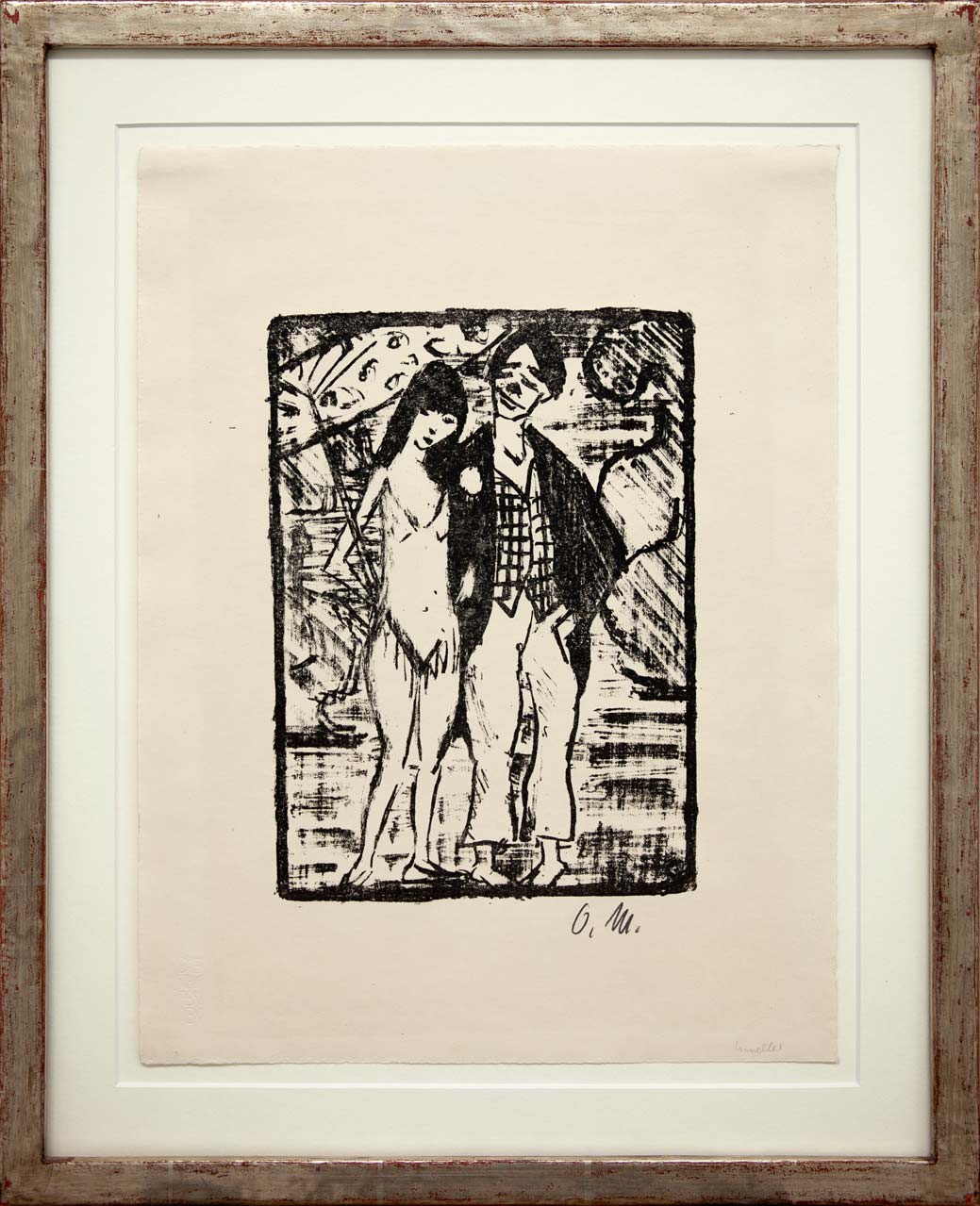


Otto Mueller
Polnische Familie
On chamois-colored vellum.
One of 60 uncounted copies prior to publication.
Monogrammed in the lower right corner.
26 x 18.8 cm to 31 x 23.5 cm.
Karsch 114 II c
Total print run: 60 uncounted advance copies prior to publication. 25 copies on Japanese paper and 100 copies on laid paper in *Die Schaffenden*, Vol. 3, No. 1, published by Paul Westheim through Gustav Kiepenheuer Verlag, Weimar, 1921.
See the painting by Lüttichau/Pirsig 200, 201 (Museum Folkwang, Essen) and the watercolor (private collection) from the same year, which shares the same title and composition (mirrored), also referred to as “The Holy Family,” “Gypsy Family,” or “Jewish Family.” The latter title is likely the most accurate, because Otto Mueller had separated from his first wife, Maschka, and wanted to marry his student from Breslau, Irene Altmann. Her father, an Orthodox Jew, was opposed to this union with a Christian. A wishful fantasy led to this composition.
The German painter, lithographer and important representative of German Expressionism Otto Mueller was born in Liebau, in what was then Prussian Silesia, in 1874. After completing an apprenticeship as a lithographer, Mueller studied painting at the Academy of Fine Arts in Dresden and at the Royal Academy of Fine Arts in Munich under Franz von Stuck, which he discontinued in order to continue his self-taught training in painting. Impressionism, Art Nouveau and Symbolism as well as works by Hans von Marées, Arnold Böcklin and Wilhelm Lehmbruck exerted a particular influence on Mueller.
In 1910, Mueller was a founding member of the “Neue Secession” along with other artists in Berlin and exhibited in the show “Rejected Artists of the Berlin Secession 1910.” From 1910 to 1913, Mueller was a member of the Expressionist artists’ groupBrücke.” Characteristic of his work during this period work simple, flat forms and natural, earthy tones combined with expressive contours. He continued to favor distemper paint, which he had been using since 1908 for his striking, slender female figures, and which he applied in thick layers to create rough surfaces. In contrast to Kirchner, Heckel, and Pechstein, Mueller’s pictorial motifs exhibit harmonious, lyrical, and decorative tendencies. A central theme of his work is the human figure in nature and the nude a landscape.
After his involvement in the First World War, Mueller held a professorship at the State Academy of Arts and Crafts in Wroclaw from 1919 until his death and was active in the circle of the "Wroclaw Artists' Bohemia". Mueller died in 1930 in Preslau, Poland.