

Ernst Ludwig Kirchner
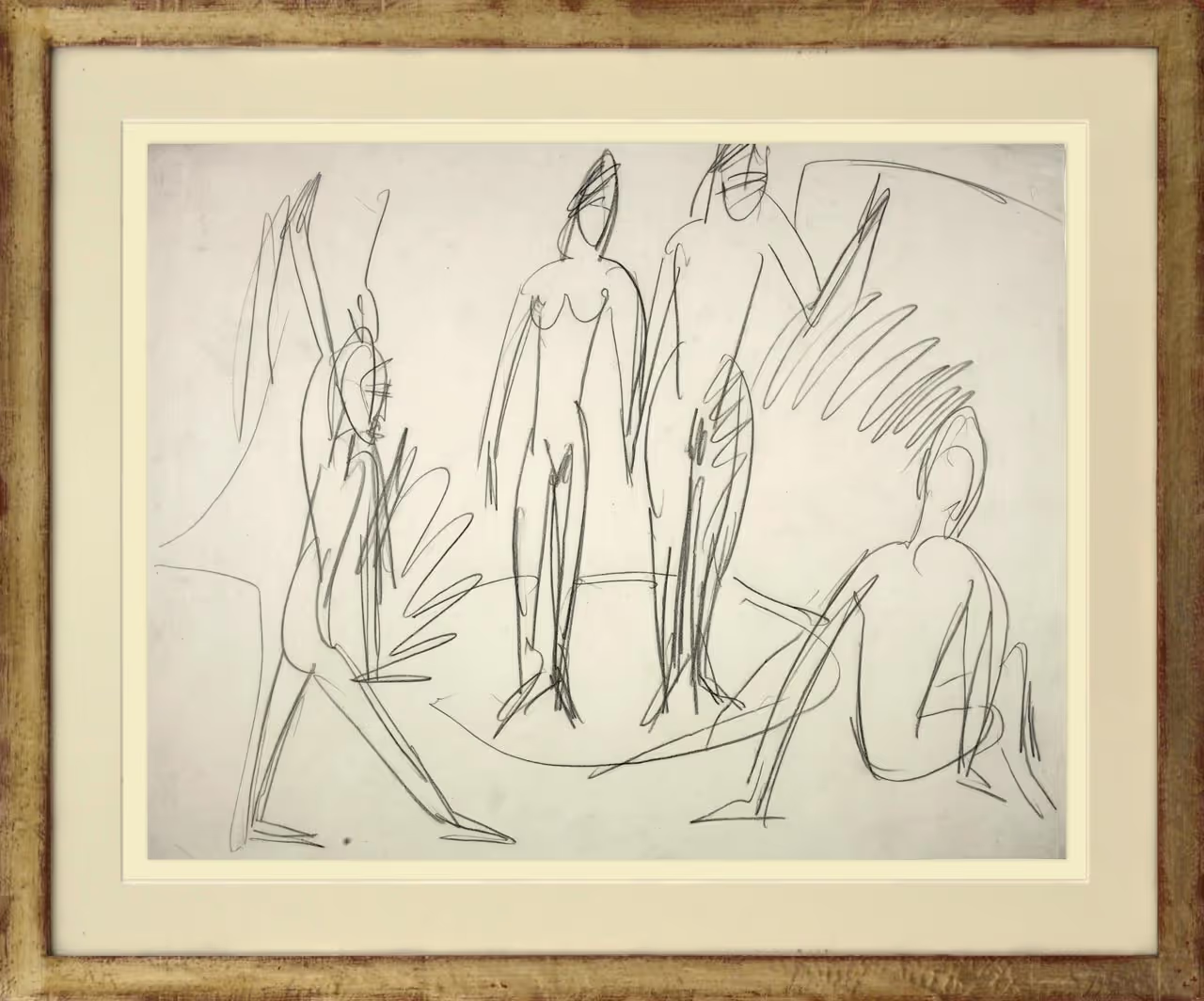
Drei Akte im Wasser
Lithography
32,6 x 38,4 cm on 37,7 x 45,5 cm
On wove paper. One of only 5 known copies so far. Signed lower right and inscribed "Handdruck". On the reverse with the estate stamp and the designation "L 157" in ink and the numbers K3535, C-1233 and 3159 in pencil and the stamp "Unverkäuflich E L Kirchner".
Gercken 460; Dube L 195
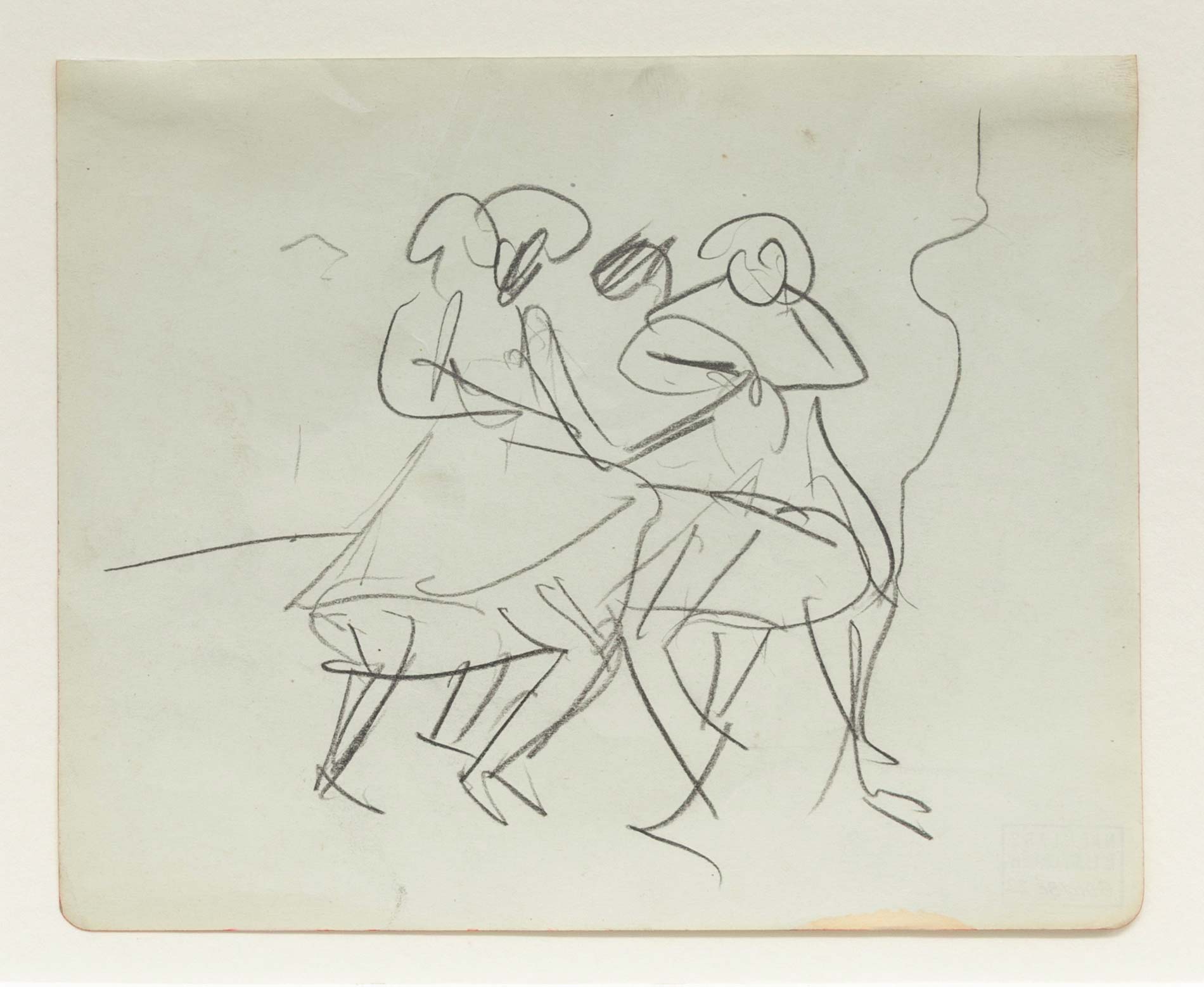
In August 1910, Kirchner made his second visit to the Moritzburg Ponds with Heckel, Pechstein, and Fränzi. Here is a heavily abbreviated bathing scene in one of the ponds. The pond itself is suggested only by the outline of the shore of a small cove running across the picture. In it, three bathers stand side by side, their lower legs in the water. Their bodies, too, are rendered in the highly simplified outlines characteristic of 1910—often consisting solely of angular or even sharply converging straight lines—giving them a bony appearance. This style was likely influenced by the slender bodies of the child models of that year.
The description by Kirchner and Schiefler:
"In the foreground is the white expanse of the riverside, interrupted by a narrow stream. Behind it is a pond with three people bathing, standing knee-deep in the water. In the center, a man standing with his legs apart (viewed from the front); on the left, a figure (viewed half from the side, facing right) walking toward him with her arms raised halfway; on the right, a standing figure (viewed half from the back, facing left). The rear shoreline of the pond in the background curves sharply outward."
Additional copies are held in the following collections: Kirchner Museum, Davos; Solomon R. Guggenheim Museum, New York; Graphic Arts Collection, Staatsgalerie Stuttgart.
On the back, on the frame's original backing board, there is a label reading: "Olbricht Collection, Meisenburgstr. 153, 45133 Essen."
Ernst Ludwig Kirchner was born in Aschaffenburg on May 6, 1880. After graduating from high school, he began studying architecture in Dresden in 1901. It was during this time that Kirchner produced his first paintings. In June 1905, he founded the artists' association Brücke together with his fellow students Fritz Bleyl, Erich Heckel and Karl Schmidt-Rottluff. In 1906, Brücke published its program in a woodcut by Kirchner. In addition to his first sculptural works, he also produced numerous prints. Experimenting with technique and color was his main focus. He met his partner Erna Schilling in Berlin in 1912. The following year, the Brücke dissolved after differences over the chronicle of Brücke written by Kirchner.
At the beginning of the First World War, Kirchner volunteered for military service despite his previous fears. However, he was soon discharged due to his poor mental health and declared unfit for service. After stays in various sanatoriums in Germany and Switzerland, Kirchner's search for healing led him to Davos for the first time in 1917. Just one year later, he moved into the farmhouse "In den Lärchen" and in 1923, together with Erna, he moved into the "Wildboden". During this time, he created sculptural furniture and began to capture the surrounding Alpine panorama in colorful paintings. His so-called New Style is characterized by an abstract formal language, contoured areas of colour and bright contrasts.
Kirchner suffers under the National Socialists' seizure of power in Germany and the defamation of his art exhibited as "degenerate". He feared that the Wehrmacht would invade Graubünden and began to paint over his paintings and destroy sculptures and printing blocks. On June 15, 1938, the artist, again marked by illness, shoots himself not far from his home.