


Erich Heckel
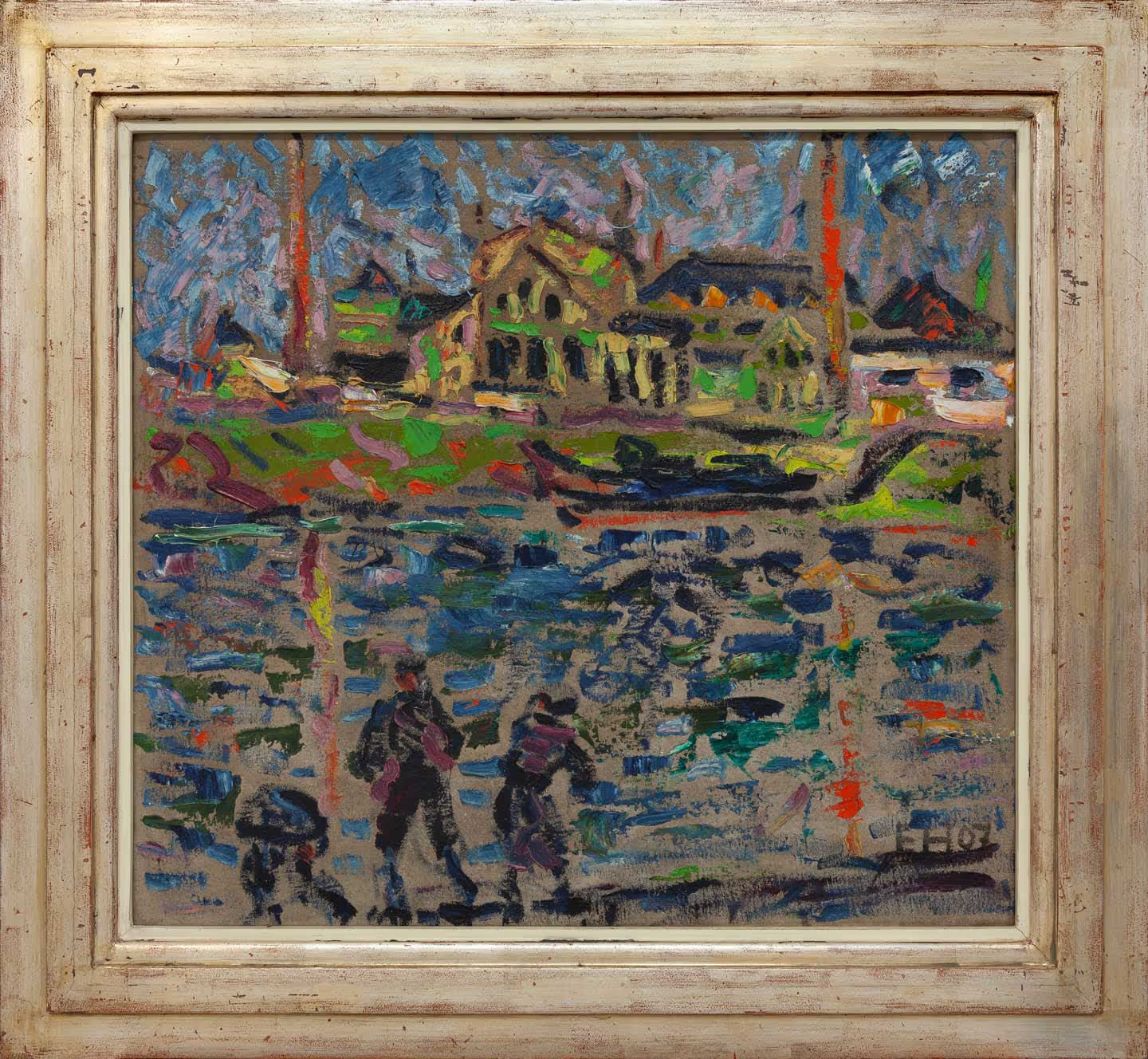
Übigau shipyard
Oil on canvas
64 x 70 cm
Monogrammed and dated in the lower right corner
Signed, titled, and dated on the back of the stretcher
Hüneke 1907–15
The Übigau shipyard was a favorite subject for Ernst Ludwig Kirchner and Erich Heckel. They typically depicted it from the banks of the Elbe in Friedrichstadt. In 1908, Kirchner created a painting (Gordon 0036, lost), an etching, and various drawings from that vantage point. The shipyard was founded in 1873 and developed into Germany’s leading inland shipyard, employing up to 1,500 people. It was closed in 1958. Some of the factory buildings have been preserved, as has the characteristic “Übigau riverside crane.”
Behind three figures on the left side of the near bank, the Elbe stretches across the scene to the line of the opposite bank, which runs horizontally just above the center of the picture. The buildings of the shipyard, with their chimneys, are reflected in the Elbe, and a barge lies in front of them on the right.
Stylistically, this painting belongs to the early Expressionist phase of a bold, late-Impressionist divisionist style, characterized by broad, short, vigorous brushstrokes, in which the Brücke, as well as Emil Nolde and many of their contemporaries, were painting at the time. Vigorous not only in the brushstrokes but also in the abbreviation of form and color, placed side by side unmixed, with white accents only occasionally appearing in the blue tones.
One of Erich Heckel’s characteristic cityscapes; rather than seeking to capture the grand, traditional veduta, he depicted scenes of everyday life and the working world in a truly striking manner.
Erich Heckel, one of the most important painters and graphic artists of German Expressionism, was born in Döbeln on the Freiberg Mulde in 1883 and spent his childhood and school years in Dresden and Chemnitz. He met Karl Schmidt-Rottluff at the Humanist Grammar School in Chemnitz and produced his first ink and watercolor studies based on nature.
In 1904, Heckel began studying architecture at the Dresden University of Technology, where he met fellow students Ernst Ludwig Kirchner and Fritz Bleyl. On June 7, 1905, they founded the artists' association "Brücke" together with Schmidt-Rottluff. Their shared interest in art and their intention to break away from the academic style of painting led to an innovative collaboration: the focus was now on the pictorial representation of their own feelings, which led to the distinctive "Brücke" style using pure, often complementary and non-naturalistic colors, angular forms and repetitive pictorial subjects (for example, the nude in nature). It was the birth of German Expressionism. In the fall of 1911, Heckel moved to Berlin, and in May 1913, Brücke finally disbanded.
After the First World War, he painted murals on wood and in secco technique and, from the 1920s onwards, more romantic-idealistic watercolor works and poetic landscapes on his annual working trips through the Alps, southern France, Italy and Germany. When the National Socialists seized power, Heckel's art was degraded as "degenerate" and removed from German museums.
In 1944, Heckel moved to Hemmenhofen on Lake Constance and took up a teaching position at the Academy of Fine Arts in Karlsruhe from 1949 to 1955. In his late work, he created circus scenes and still lifes in delicate colors. Heckel died in Hemmenhofen in 1970.