

Erich Heckel
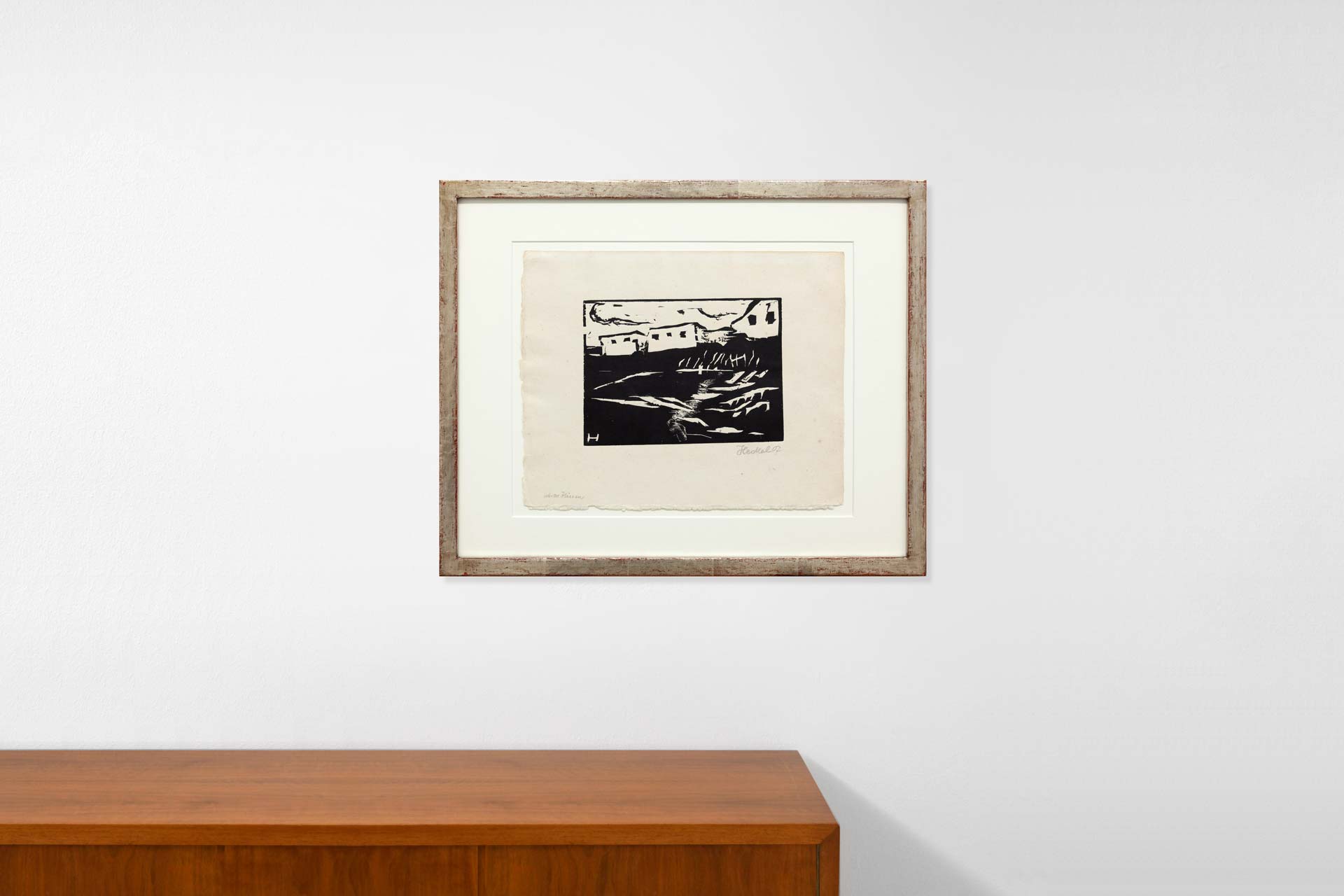
Weisse Häuser (Weisse Schuppen)
Woodcut on soft, ivory-colored handmade paper.
One of eight prints by the artist that have come to light so far.
Signed and dated in the lower right corner, with the title in the lower left corner of the paper. 15.8 x 21.7 cm on 28.4 x 35.1 cm
This woodcut is extremely rare.
Subject of the first summer stay in Dangast. Probably simple cottages in the Dangast Moor near Dangast on the Jadebusen, Oldenburg, where Heckel worked with Karl Schmidt-Rottluff in the fall of 1907; perhaps also houses, stables, or sheds in the Dresden area. A consistent theme in the work ofBrücke artists had already emerged: they were hardly inspired by significant or well-known features of the landscape; they preferred simple subjects such as a brickworks, a red bathing hut, etc. Their focus was on the essence, not the subject itself.
Erich Heckel, one of the most important painters and graphic artists of German Expressionism, was born in Döbeln on the Freiberg Mulde in 1883 and spent his childhood and school years in Dresden and Chemnitz. He met Karl Schmidt-Rottluff at the Humanist Grammar School in Chemnitz and produced his first ink and watercolor studies based on nature.
In 1904, Heckel began studying architecture at the Dresden University of Technology, where he met fellow students Ernst Ludwig Kirchner and Fritz Bleyl. On June 7, 1905, they founded the artists' association "Brücke" together with Schmidt-Rottluff. Their shared interest in art and their intention to break away from the academic style of painting led to an innovative collaboration: the focus was now on the pictorial representation of their own feelings, which led to the distinctive "Brücke" style using pure, often complementary and non-naturalistic colors, angular forms and repetitive pictorial subjects (for example, the nude in nature). It was the birth of German Expressionism. In the fall of 1911, Heckel moved to Berlin, and in May 1913, Brücke finally disbanded.
After the First World War, he painted murals on wood and in secco technique and, from the 1920s onwards, more romantic-idealistic watercolor works and poetic landscapes on his annual working trips through the Alps, southern France, Italy and Germany. When the National Socialists seized power, Heckel's art was degraded as "degenerate" and removed from German museums.
In 1944, Heckel moved to Hemmenhofen on Lake Constance and took up a teaching position at the Academy of Fine Arts in Karlsruhe from 1949 to 1955. In his late work, he created circus scenes and still lifes in delicate colors. Heckel died in Hemmenhofen in 1970.