

Erich Heckel
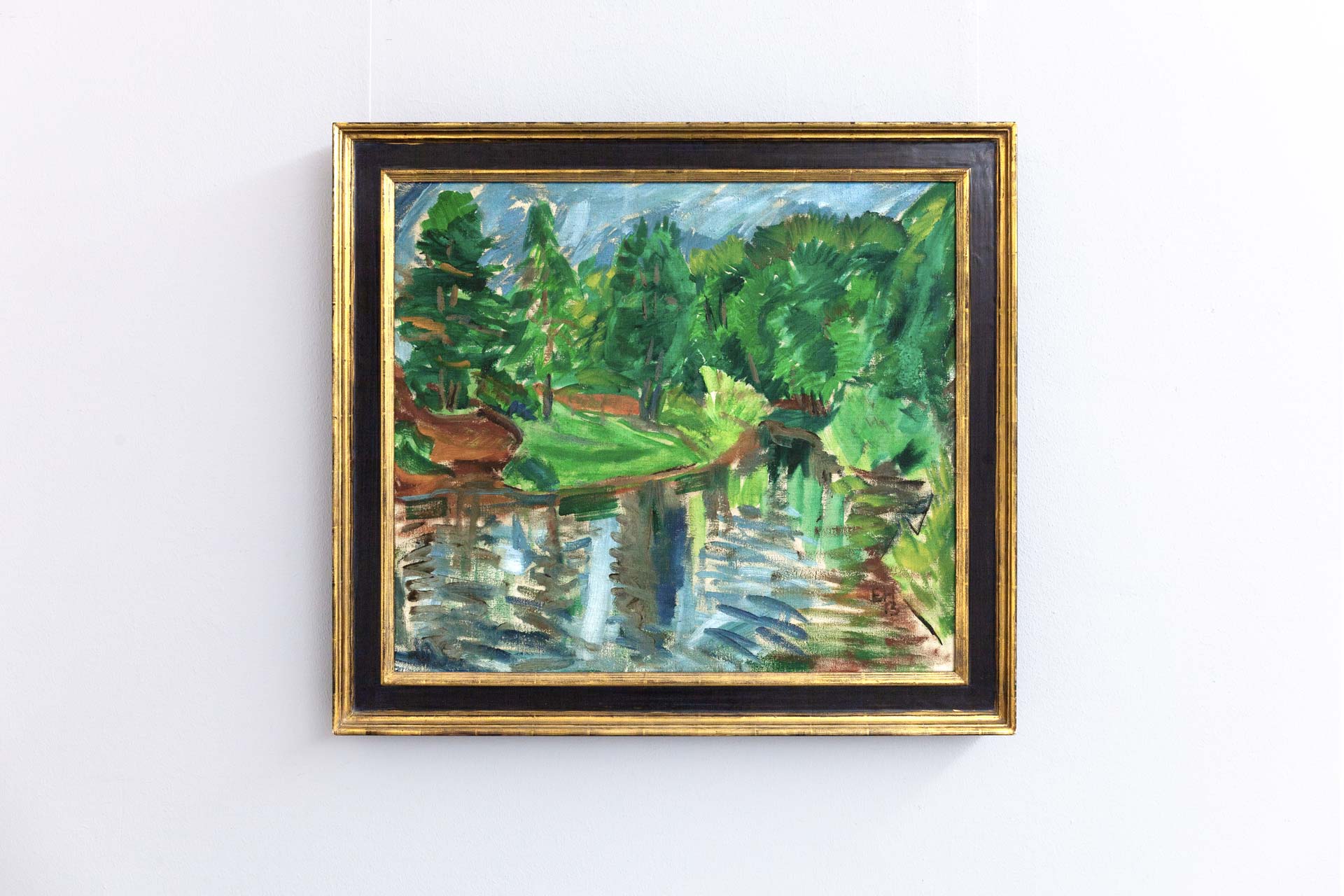
Alster landscape
Oil and tempera on canvas
69,5 x 79 cm
Lower right monogrammed and dated "EH 13". Signed on the reverse of the canvas in black "Erich Heckel".
Hüneke 1913-29
The painting was acquired as early as 1914 by Prof. Dr. Richard Hessberg (1879–1960), an ophthalmologist and collector from Essen. Following his death in 1960 at the latest, the painting passed to his son, Dr. Klaus Hessberg, who donated it to the Museum Folkwang on permanent loan.
Through his stays in Dangast on the Jade Bay, Karl Schmidt-Rottluff had already established a circle of collectors and friends in Hamburg by 1907. In October 1910, Erich Heckel and Ernst Ludwig Kirchner also traveled to Hamburg and visited Gustav Schiefler, the driving force behind the earlyBrücke collectors’ circle there, and in the following years frequently visited his country house in Mellingstedt, where Heckel depicted various Alster landscapes and the Mellingburg Lock using a variety of techniques.
As is so often the case in Erich Heckel’s landscapes, the lower half is dominated by a river—in this case, the narrow Alster, which widens into a small pond. The opposite bank divides the composition horizontally down the middle. On the right, the Alster disappears slightly higher up beneath the trees, which dominate the upper half of the picture, leaving only a small portion of the blue sky above visible.
Although the blue reflected on the water’s surface also dominates the lower half, the composition is nevertheless dominated by the green of the trees—a spring green. The park landscape becomes a scene of vegetation.
The pure landscape was already of great importance in Erich Heckel’s early work. In the decades that followed, right up through the 1950s, it became the dominant theme. It allowed him to develop his distinctive style of pure painting without being distracted by specific, defining objects or people. Here, in the vigorous, expressive brushstrokes of 1913.
Erich Heckel, one of the most important painters and graphic artists of German Expressionism, was born in Döbeln on the Freiberg Mulde in 1883 and spent his childhood and school years in Dresden and Chemnitz. He met Karl Schmidt-Rottluff at the Humanist Grammar School in Chemnitz and produced his first ink and watercolor studies based on nature.
In 1904, Heckel began studying architecture at the Dresden University of Technology, where he met fellow students Ernst Ludwig Kirchner and Fritz Bleyl. On June 7, 1905, they founded the artists' association "Brücke" together with Schmidt-Rottluff. Their shared interest in art and their intention to break away from the academic style of painting led to an innovative collaboration: the focus was now on the pictorial representation of their own feelings, which led to the distinctive "Brücke" style using pure, often complementary and non-naturalistic colors, angular forms and repetitive pictorial subjects (for example, the nude in nature). It was the birth of German Expressionism. In the fall of 1911, Heckel moved to Berlin, and in May 1913, Brücke finally disbanded.
After the First World War, he painted murals on wood and in secco technique and, from the 1920s onwards, more romantic-idealistic watercolor works and poetic landscapes on his annual working trips through the Alps, southern France, Italy and Germany. When the National Socialists seized power, Heckel's art was degraded as "degenerate" and removed from German museums.
In 1944, Heckel moved to Hemmenhofen on Lake Constance and took up a teaching position at the Academy of Fine Arts in Karlsruhe from 1949 to 1955. In his late work, he created circus scenes and still lifes in delicate colors. Heckel died in Hemmenhofen in 1970.