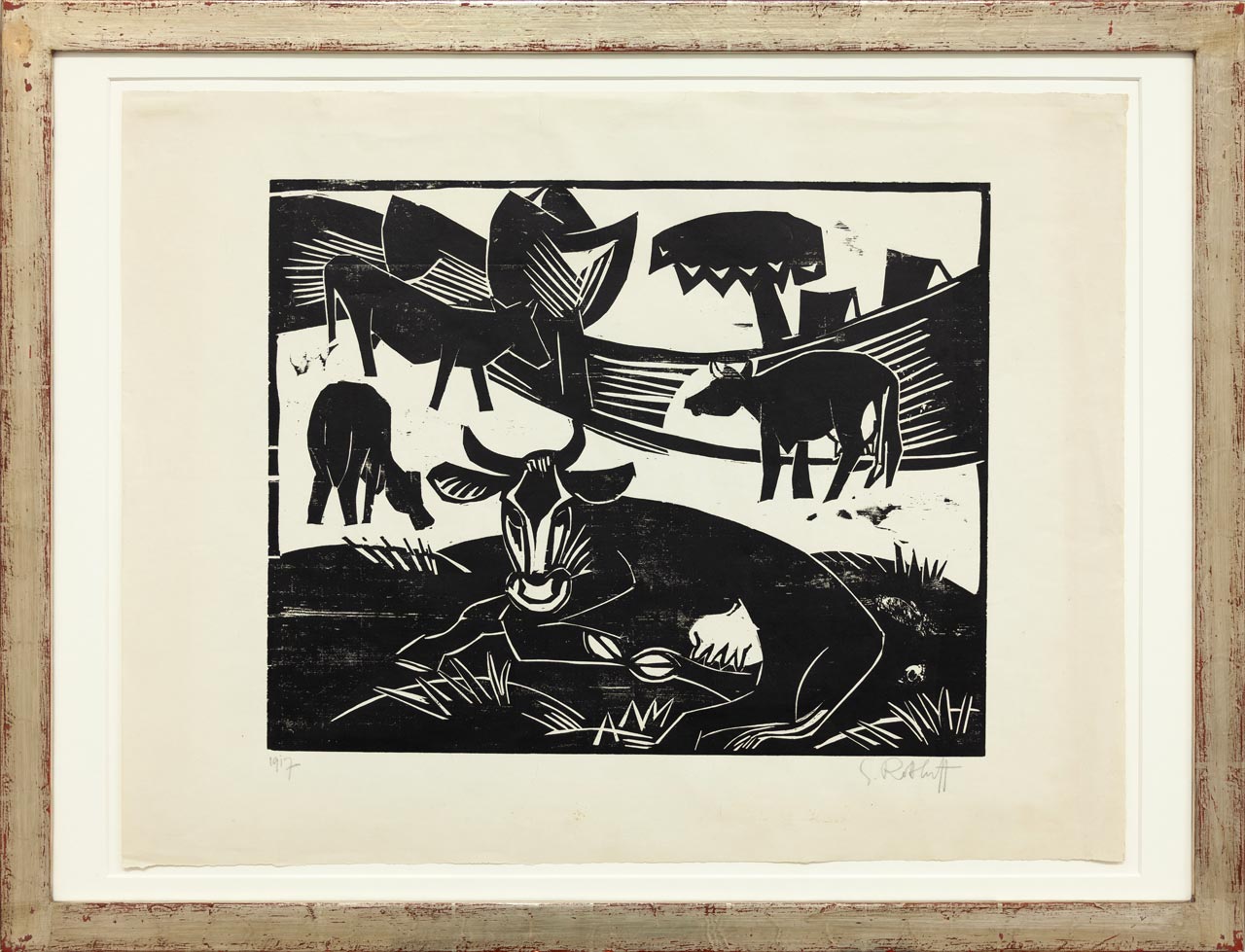


Karl Schmidt-Rottluff
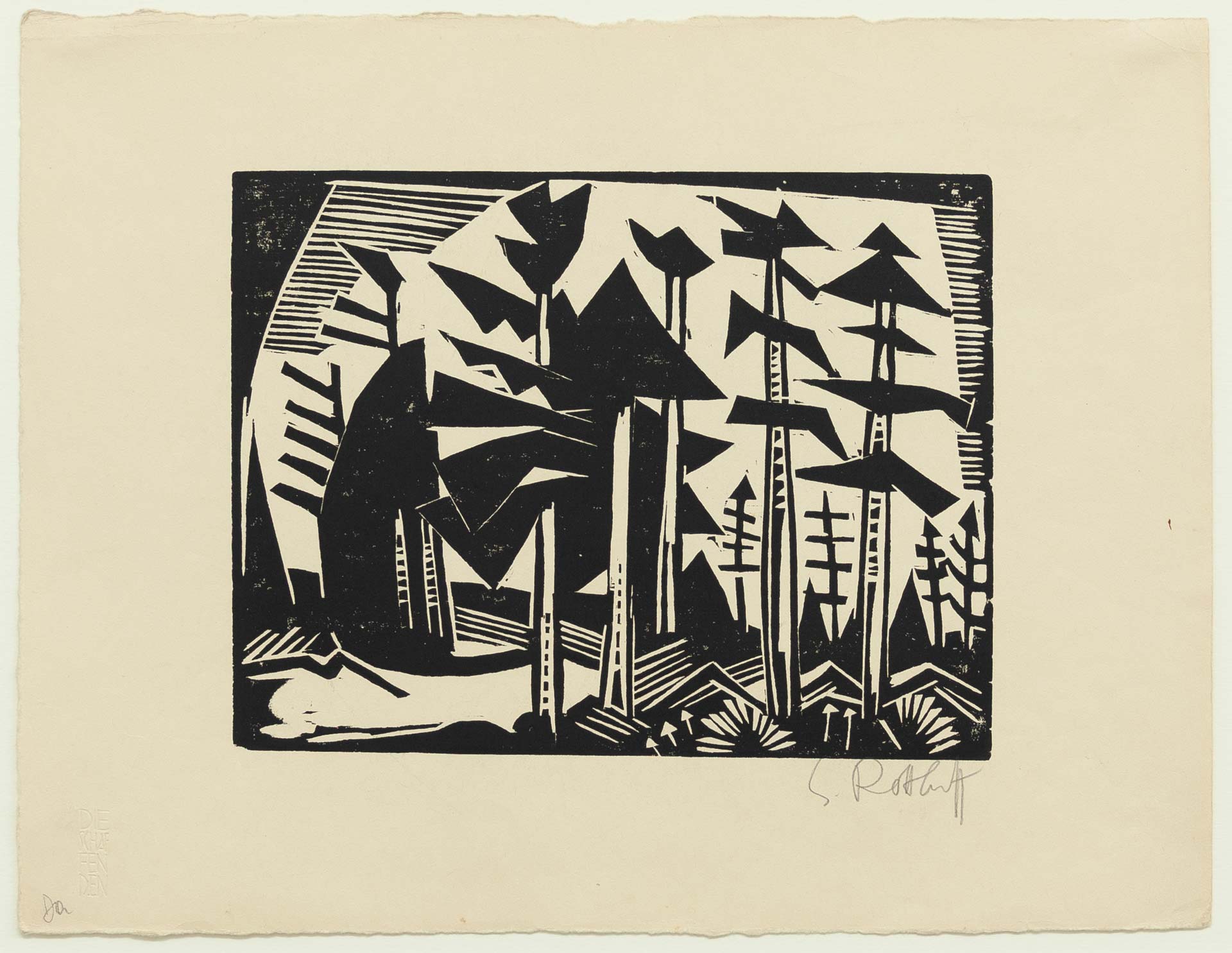
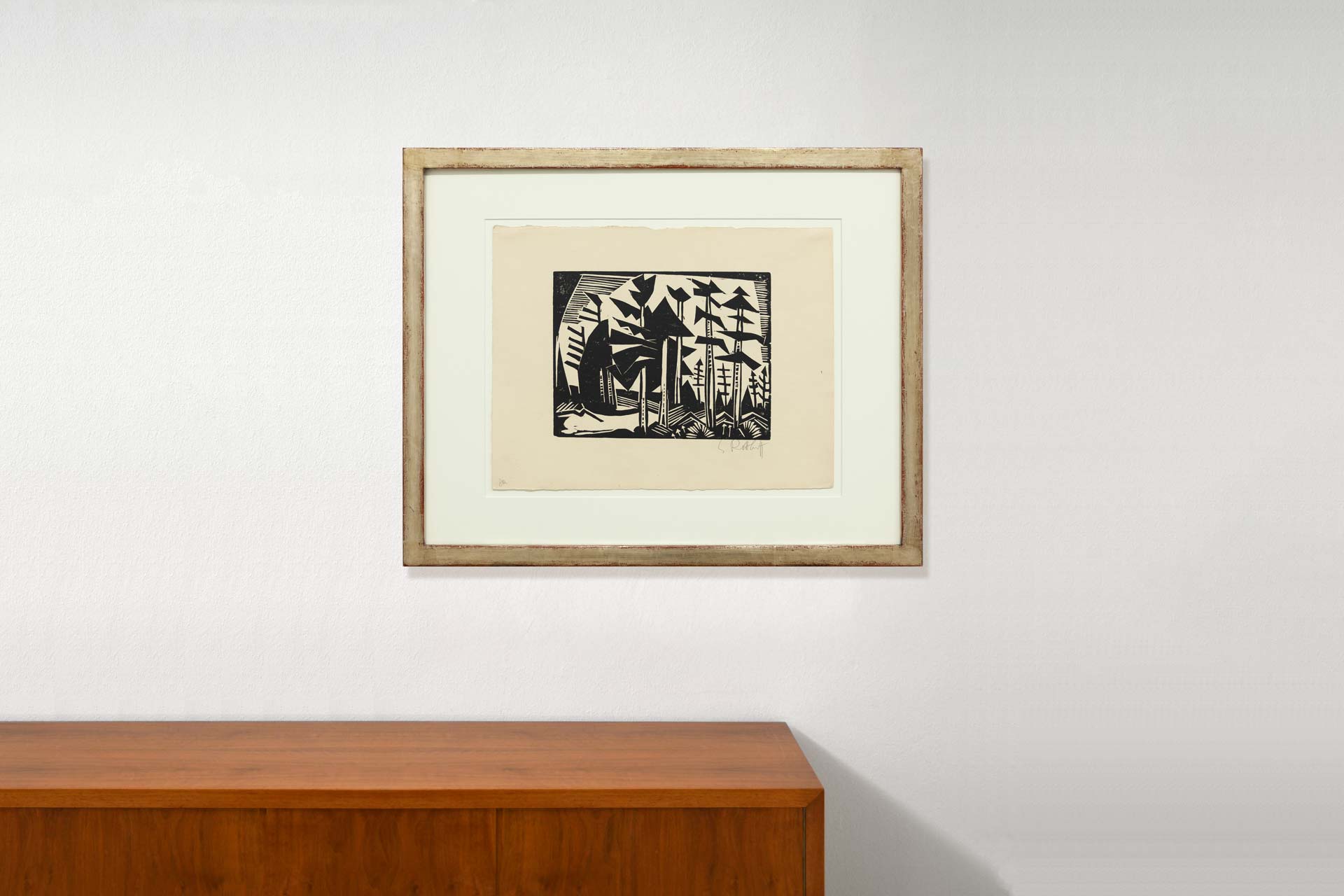
Landschaft (Russischer Wald)
Printed in Japan. One of 25 prints on this paper.
Signed in pencil in the lower right corner. Inscribed "DA" in pencil in the lower left corner.
20.1 x 26.2 to 31.6 x 41.2 cm.
Schapire 229
During World War I, Karl Schmidt-Rottluff was stationed in Kaunas—in present-day Lithuania—first as a soldier and later as a staff member of the press office. In his letters home, he expresses his enthusiasm for the landscape he encounters. In a letter to the Herrmanns in Berlin dated July 4, 1915, he writes jokingly: “If I keep wandering around Russia much longer, all my patriotism and German pride are in danger of being destroyed—I like the Russian landscape, with its great Slavic dreaminess, far too much.” He produced several woodcuts that bear witness to this. As the war years wore on, however, the artist’s exhaustion and dissatisfaction with the war situation also grew. This is particularly evident in the woodcut “Landscape (Russian Forest).” The conifers soar high into the sky and appear sharp-edged, like swords. They seem emaciated, yet their steadfastness suggests they are enduring. One might think that with this woodcut, Schmidt-Rottluff created, so to speak, a metaphor for the condition of the soldiers in the final months of the war.
From: *Die Schaffenden*, Vol. II, Issue 3, Gustav Kiepenheuer, Weimar 1920.
As a co-founder of the Dresden artists' association "Brücke" and an important representative of German Expressionism, Karl Schmidt-Rottluff, born in Rottluff in 1884, was one of the most important artists, graphic artists and sculptors of Modern art. Following the "Brücke" guiding principle, Schmidt-Rottluff sought avant-garde ways of expressing a new style of art and life in the formal simplification, deliberate coarsening and exaggeration of color. His preferred motifs included people in motion and in nature, the nude, the circus, vaudeville, life in the big city and the untouched landscapes of the North and Baltic Seas.
While still at school in Chemnitz, Schmidt-Rottluff met Erich Heckel, who was one year his junior, and began studying architecture with him at the Technical University in Dresden in 1905. There, together with fellow students Ernst Ludwig Kirchner and Fritz Bleyl, he founded the "Brücke" (until 1913) and began working as a freelance artist. Schmidt-Rottluff spent the summers in Dangast (1907-1910). In 1911, he moved to Berlin together with Kirchner and Heckel and took part in important exhibitions, such as the "Neue Secession" in Berlin (1910) and the 2nd exhibition of the "Blaue Reiter" in Munich (1912). Stays on the Baltic Sea (Fehmarn, Nidden and Hohwacht) and in the 1930s in Jershöft and in Italy, Paris and Ticino followed. During the Second World War, he was defamed by the National Socialists as a "degenerate" artist and banned from exhibiting and painting. In 1947, he was appointed professor at the Kunsthochschule in Berlin Charlottenburg and took part in the first documenta in Kassel in 1955.
In 1964, he initiated the founding of the Brücke Museum in Berlin-Dahlem and continued to acquire works for the collection until his death in 1976.
-Rahmen_web.jpg)