

Karl Schmidt-Rottluff
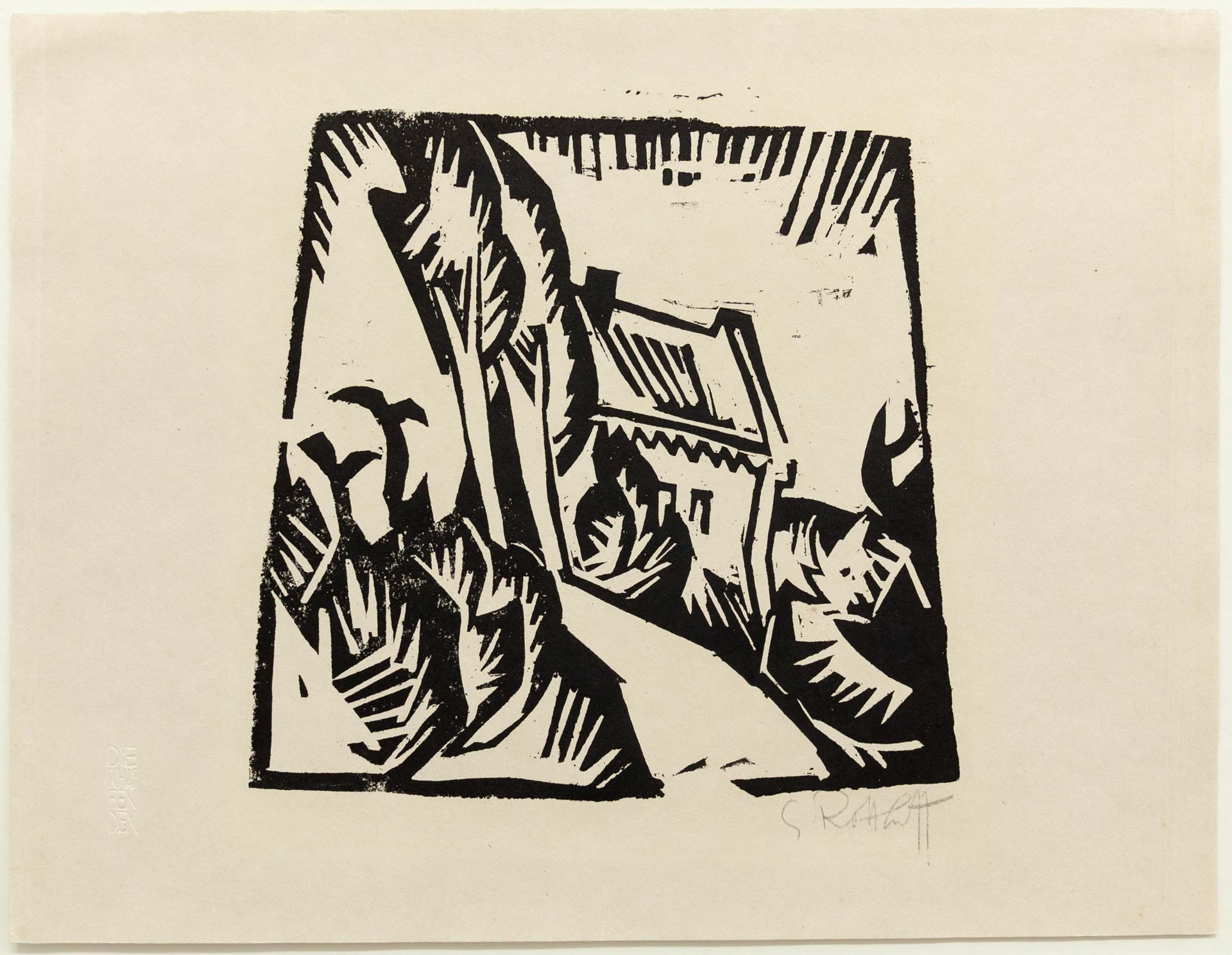
Haus mit Pappeln
On chamois-colored vellum.
Signed in the lower right corner. In the lower left corner, there is a dry stamp reading "Die Schaffenden."
23.7 x 24.7 to 32 x 42 cm.
Schapire H 118
One of 100 copies on this paper, published in *Die Schaffenden*, Vol. 1, Issue 1, Sheet No. 10, edited by Paul Westheim and published by Gustav Kiepenheuer Verlag, Weimar, 1920; total print run: 125 copies. Reproduced in: *Das Kunstblatt* 1917, Issue 11; *Cicerone* 1918, Issues 5–6.
Karl Schmidt-Rottluff created this woodcut in the summer of 1913 in Nidden on the Curonian Spit. Compare the mirror-reversed motif in the 1913 painting "The Red House."
Through the trapezoidal shape of the woodcut, which tapers upward, Schmidt-Rottluff enhances the expressiveness of his depiction. The landscape is further enlivened by incised parallel lines and angular shifts in direction.
As a co-founder of the Dresden artists' association "Brücke" and an important representative of German Expressionism, Karl Schmidt-Rottluff, born in Rottluff in 1884, was one of the most important artists, graphic artists and sculptors of Modern art. Following the "Brücke" guiding principle, Schmidt-Rottluff sought avant-garde ways of expressing a new style of art and life in the formal simplification, deliberate coarsening and exaggeration of color. His preferred motifs included people in motion and in nature, the nude, the circus, vaudeville, life in the big city and the untouched landscapes of the North and Baltic Seas.
While still at school in Chemnitz, Schmidt-Rottluff met Erich Heckel, who was one year his junior, and began studying architecture with him at the Technical University in Dresden in 1905. There, together with fellow students Ernst Ludwig Kirchner and Fritz Bleyl, he founded the "Brücke" (until 1913) and began working as a freelance artist. Schmidt-Rottluff spent the summers in Dangast (1907-1910). In 1911, he moved to Berlin together with Kirchner and Heckel and took part in important exhibitions, such as the "Neue Secession" in Berlin (1910) and the 2nd exhibition of the "Blaue Reiter" in Munich (1912). Stays on the Baltic Sea (Fehmarn, Nidden and Hohwacht) and in the 1930s in Jershöft and in Italy, Paris and Ticino followed. During the Second World War, he was defamed by the National Socialists as a "degenerate" artist and banned from exhibiting and painting. In 1947, he was appointed professor at the Kunsthochschule in Berlin Charlottenburg and took part in the first documenta in Kassel in 1955.
In 1964, he initiated the founding of the Brücke Museum in Berlin-Dahlem and continued to acquire works for the collection until his death in 1976.


-Rahmen_web.jpg)