Ernst Ludwig Kirchner
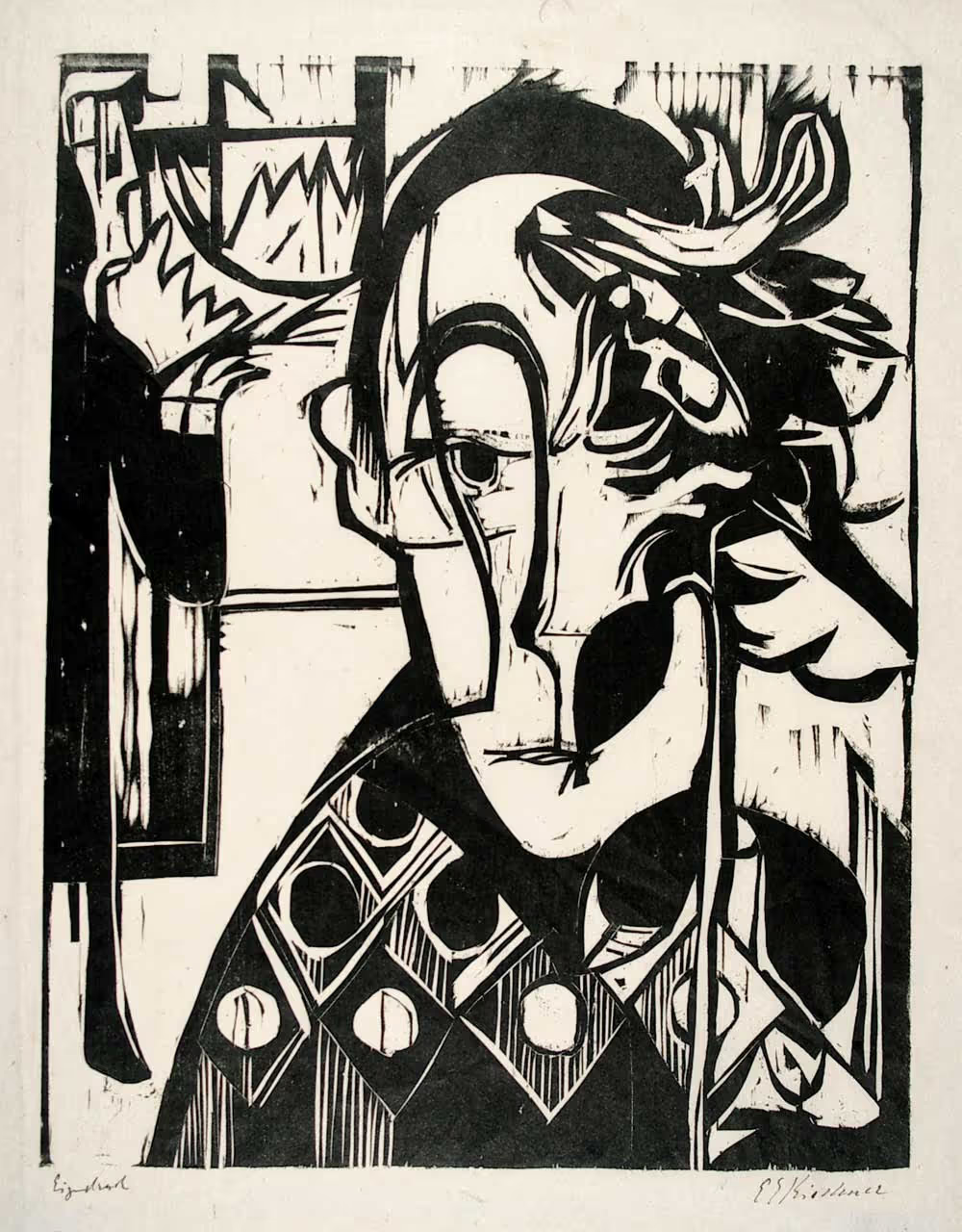
Junger Hirt mit Pfeife
Etching
On a sheet of copperplate printboard glued together, mounted on cardboard bearing the Schiefler number. One of 5 prints by the artist known to exist so far.
25.2 x 20 to 31 x 24 cm. On the back, it bears the estate stamp and the designation "R 250 IV" in ink, as well as "K9671" in pencil.
Gercken 1100; Dube R 320 IV
An intricately executed print titled “Young Shepherd with Pipe” from 1920, which combines line etching, area etching, drypoint, and even the file-working technique that Kirchner frequently employed. Only one copy of each of the four states is known to exist. The fourth and final state offered here can therefore be considered a one-of-a-kind piece.
In 1919, Kirchner photographed several young shepherds, including one wearing such a hat and holding a long cigar in his mouth—twice (Scotti 53, 280). Here, one such shepherd is seen in front of a wooden hut; to his left are the round wooden beams of the side wall. That year, Kirchner painted portraits of many of his neighbors using a variety of techniques; not all of the subjects have been identified to date.
Ernst Ludwig Kirchner was born in Aschaffenburg on May 6, 1880. After graduating from high school, he began studying architecture in Dresden in 1901. It was during this time that Kirchner produced his first paintings. In June 1905, he founded the artists' association Brücke together with his fellow students Fritz Bleyl, Erich Heckel and Karl Schmidt-Rottluff. In 1906, Brücke published its program in a woodcut by Kirchner. In addition to his first sculptural works, he also produced numerous prints. Experimenting with technique and color was his main focus. He met his partner Erna Schilling in Berlin in 1912. The following year, the Brücke dissolved after differences over the chronicle of Brücke written by Kirchner.
At the beginning of the First World War, Kirchner volunteered for military service despite his previous fears. However, he was soon discharged due to his poor mental health and declared unfit for service. After stays in various sanatoriums in Germany and Switzerland, Kirchner's search for healing led him to Davos for the first time in 1917. Just one year later, he moved into the farmhouse "In den Lärchen" and in 1923, together with Erna, he moved into the "Wildboden". During this time, he created sculptural furniture and began to capture the surrounding Alpine panorama in colorful paintings. His so-called New Style is characterized by an abstract formal language, contoured areas of colour and bright contrasts.
Kirchner suffers under the National Socialists' seizure of power in Germany and the defamation of his art exhibited as "degenerate". He feared that the Wehrmacht would invade Graubünden and began to paint over his paintings and destroy sculptures and printing blocks. On June 15, 1938, the artist, again marked by illness, shoots himself not far from his home.