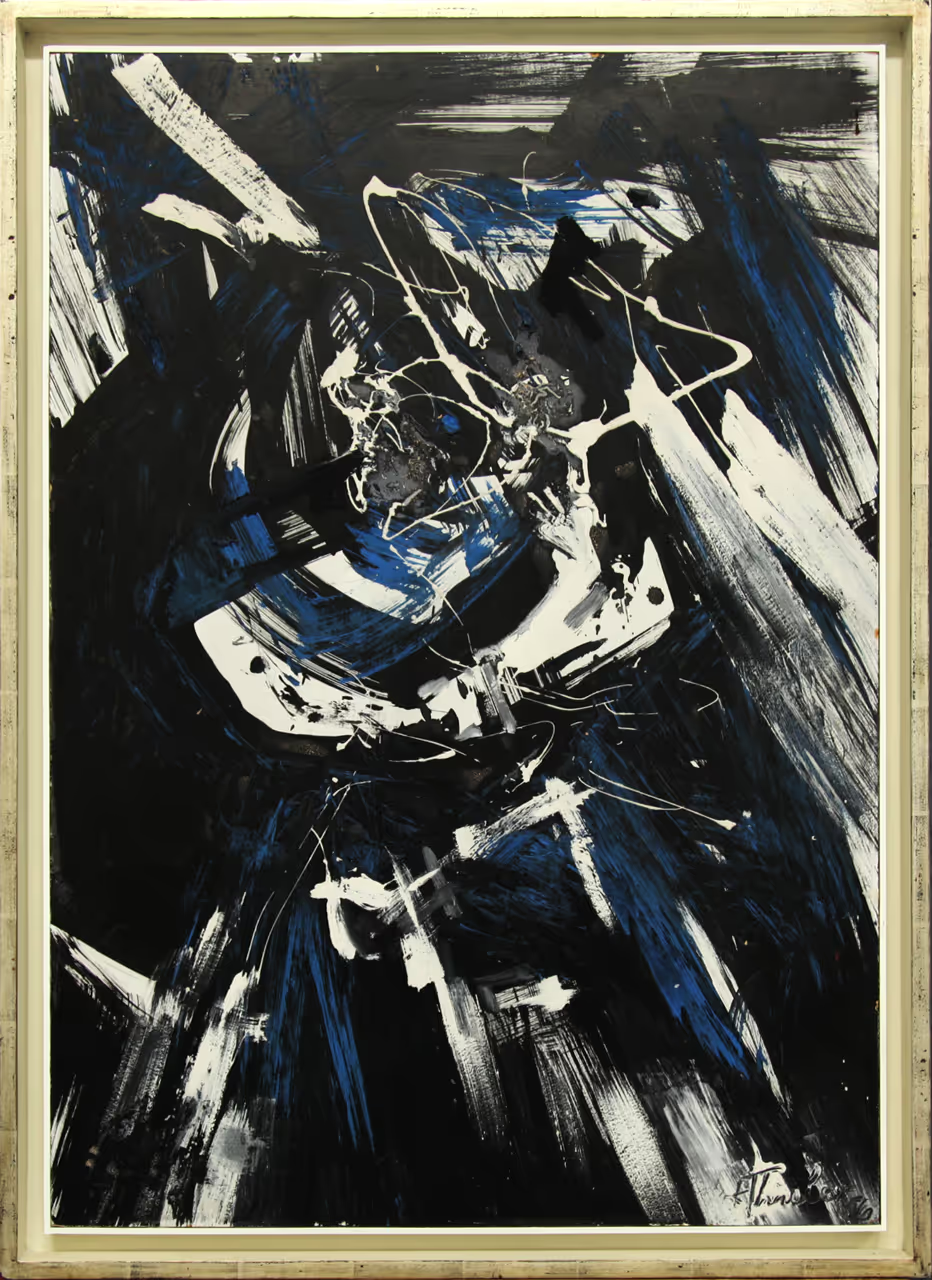


Fred Thieler
Kometenschauer
Mixed media on canvas
Signed and dated lower left.
115 x 120 cm.
Signed, dated, and titled on the back of the canvas. Labeled "No. 28" on the stretcher.
Melchior 9/53
1948, the fateful year for abstraction, left its mark on the life and work of Fred Thieler (1916–1999). After completing his military service and going into hiding in Munich—partly because of and partly alongside his Jewish mother—he nevertheless found the courage to attend a private art school there. From 1946 to 1950, he studied under Karl Caspar at the Academy of Arts and painted his first abstract works. From 1951 to 1953, he lived and worked in Paris; in 1952, he became a member of the ZEN49 group.
Thieler is an outstanding representative of the Informel movement in a particularly expressive variant. The following small selection of his exhibition participations may illustrate his significance: 1958: 29th Venice Biennale; 1959: documenta II, Kassel; 1964: documenta III, Kassel; 1984: *von hier aus*, Düsseldorf.
Fred Thieler, born in Königsberg in 1916, is one of the most important representatives of Art Informel and the main protagonist of German art after 1945. Art Informel is a collective term for a style of abstract painting that emerged in Europe and the USA after the Second World War. At its heart is the detachment from all formal conditions and the radical departure from traditional pictorial composition.
In Thieler's work, this is reflected in a departure from the initially figurative painting and a turn towards the "emptying of painting": early depictions of people, landscapes and still lifes give way to formless, gestural and dynamic spaces of color. The paint is applied to the canvas while moving and dripping, creating sweeping compositions reminiscent of American action painting.
Thieler initially began studying medicine in Königsberg in 1936, which he had to abandon in 1941 due to the National Socialist dictatorship and an imposed professional ban. Despite persecution by the National Socialists (Thieler's mother was Jewish), he studied at a private painting school under Hein König in Munich and later worked in hiding with the White Rose movement. After the Second World War, Thieler studied painting at the Academy of Fine Arts in Munich under Carl Caspar from 1946 to 1950. He created his first abstract works.
In the 1950s, Thieler spent time in Holland and later in Paris, where he became friends with Hans Hartung, Serge Poliakoff and Pierre Soulages and worked in "Atelier 17". In 1952, Thieler became an official member of the avant-garde artists' group "ZEN 49" in Munich. In post-war Germany, the non-objective painting of "ZEN 49" served as an expression of freedom and diversity. In 1953, Thieler became a member of the Neue Gruppe München and shortly afterwards was accepted into the Deutscher Künstlerbund. From 1959 to 1981 he held a professorship at the Hochschule für Bildende Künste in Berlin, and from 1972 to 1973 he was also a visiting professor at the College of Art and Design in Minneapolis. Thieler received numerous awards, including the Lovis Corinth Prize and the German Federal Cross of Merit. Since 1991, the Fred Thieler Prize for young painters has been awarded by the Berlinische Galerie. Thieler died in Berlin in 1999.