


Emil Nolde
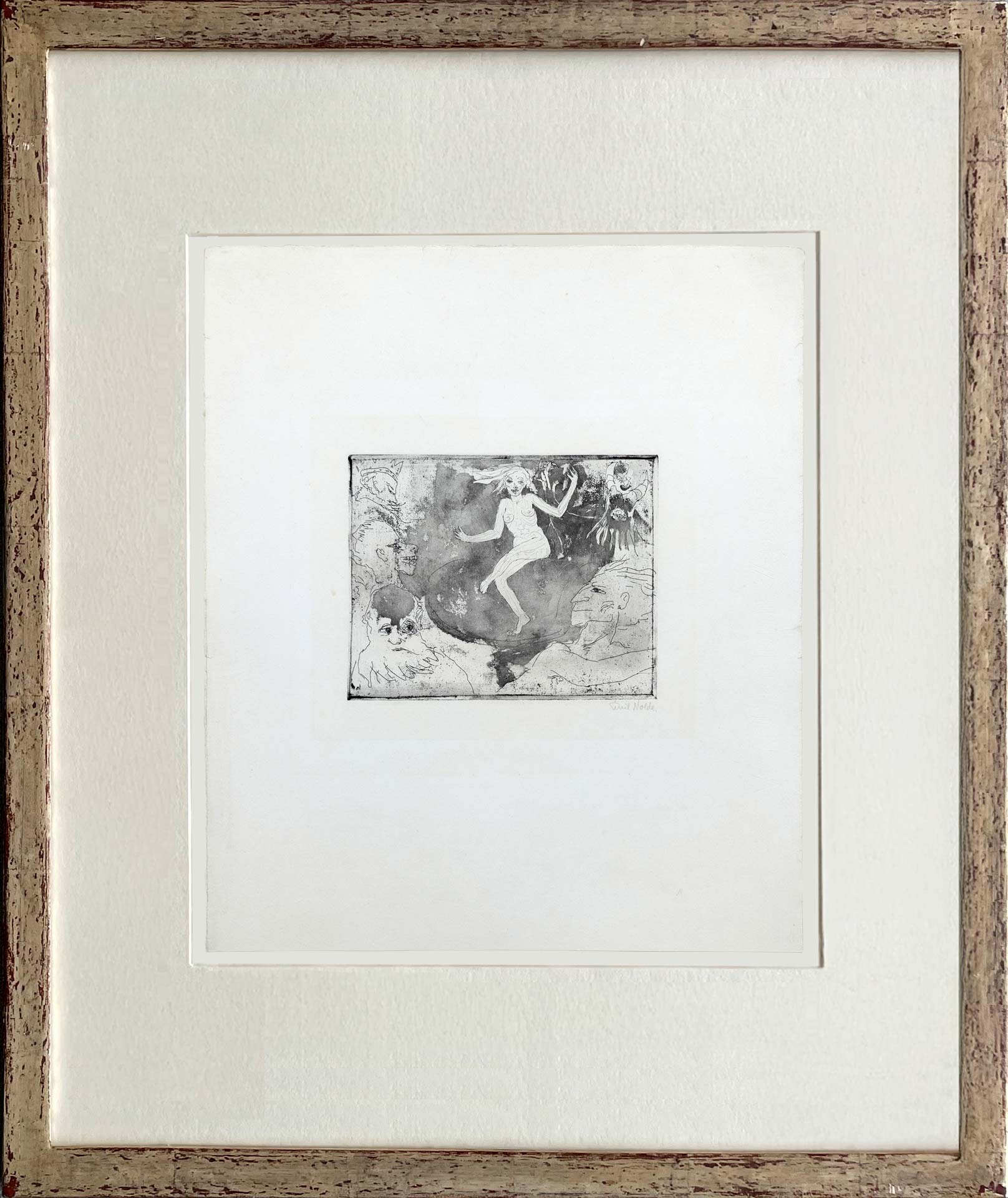
Der Tod als Tänzerin
Etching (line and tone etching)
On vellum. Signed in pencil in the lower right corner. Second (final) state.
Schiefler has recorded at least 18 instances of this condition.
Schiefler-Mosel R 200 II
Nolde’s striking etching “Death as a Dancer” takes up the late-medieval motif of the Dance of Death and depicts grotesque male figures surrounding a dancing girl through whose skin her bones are already visible. With lines that are both energetic and concise, Nolde captures the dancer’s vitality and psychological intensity.Sophisticated and insidious, the camouflage of Death as a youthfully beautiful nude dancer with long, flowing hair, surrounded by a circle of rather elderly gentlemen who may not even notice the skeleton of Death shining through her beautiful, delicate body. One senses what will happen when the dance comes to an end.
As one of the leading painters, watercolorists and graphic artists of German Expressionism in the 20th century, Emil Nolde is particularly known for his expressive and intense colors. At the same time, tendencies towards abstraction are visible in his two-dimensional compositions with hard contours in bright colors.
Born in 1867 in Nolde, Schleswig-Holstein, Nolde completed an apprenticeship as a carver and draughtsman at the School of Arts and Crafts in Flensburg in 1884 and worked as a freelance artist from 1898, initially with small colorful drawings of the Swiss mountains. After studying at Adolf Hölzel's painting school in Dachau and at the Académie Julian in Paris, Nolde increasingly abandoned lyrical landscape paintings and devoted himself to more colorful flower and garden paintings. Nolde accepted an invitation from the Expressionist artists' association "Brücke" in 1906 and established another graphic technique in the group, etching, established contacts with collectors and initiated the group's "passive memberships" and "annual gifts", which were subject to a fee. After leaving the group in 1907, Nolde joined the "Berliner Secession" in 1909 and shortly afterwards became a co-founder of the "Neue Secession". He produced his first religious works with Christian themes and pictures of Berlin's nightlife. Nolde travels to Europe and takes part in a German New Guinea expedition of the Imperial Colonial Office lasting just under a year. In 1926, Nolde and his wife Ada finally moved to Seebüll, where he devoted himself intensively to painting.
The role of Emil Nolde under National Socialism is the subject of lively debate among researchers. What is new is that Emil Nolde, although ostracized as a "degenerate" artist from 1937 and banned from his profession in 1941, remained a supporter of the Nazi regime until the collapse of the Third Reich. This is confirmed by the initial results of a historical study supported by the Nolde Foundation on Emil Nolde's links to National Socialism. The Foundation sees it as its duty to clarify past misconceptions about Emil Nolde as a phenomenon of German post-war repression. Furthermore, new findings and conclusions are to be introduced into the scholarly reappraisal of the extensive work of one of the most famous German expressionists.
Nolde died in Seebüll in 1956.